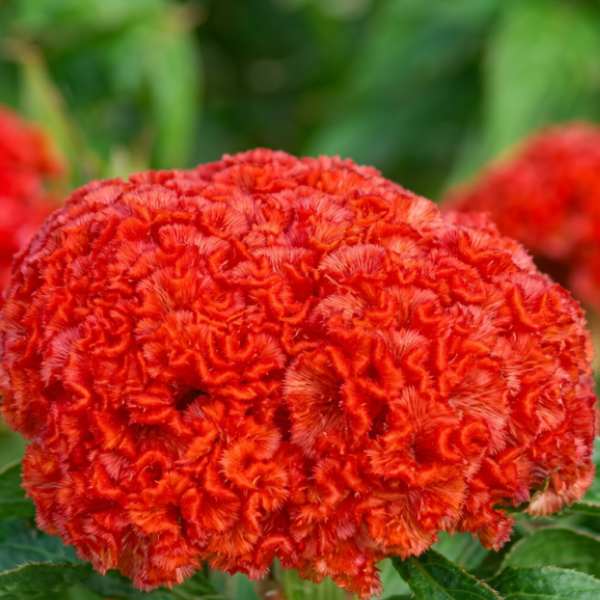
Product images shown online are intended to represent the mature, finished plant, including its expected color, growth habit, and overall appearance. They are not intended to depict the size or fullness of the starter plug at the time of shipment.
Tray Size
Sold in Liners of 100
Price Per Plug:
38.0 ¢
Total Per Tray:
$38.00
Partial Tray
Price Per Plug:
57.0 ¢
Split Tray of 35 - Total:
$19.95
6387386Preorder for your desired ship date! North Carolina Farms, Inc.
Chief Persimmon, like the other Chief series varieties, was developed for the professional cut flower industry. This high-performance cultivar produces strong stems topped with dense, velvety flower heads. These robust plants reach a mature height of approximately 32 to 40 inches and require full sun and well-drained soil to support their large, showy blooms. For a sophisticated floral display, consider pairing it with companions like sunflowers (Helianthus annuus), Snapdragons, or Dianthus barbatus.
Chief Persimmon Selling Tips
Sell Chief Persimmon to those looking for high-performance cut flowers offering the exceptional stem strength and flower density required for high-end bouquets and large-scale landscape displays. Customers will benefit from its heat-loving nature and blooms that maintain their intense persimmon color even in the height of summer. Its excellent vase life and suitability for drying make it a versatile and reliable choice for both home decorators and floral enthusiasts.
General Growing Tips For Your Seedling Tray
Use a well-drained media with a pH of 5.8–6.2 and provide a light, constant feed of 100 ppm Nitrogen, ensuring sufficient potassium is provided to prevent abnormal flower shapes. Chief Persimmon is a quantitative short-day plant and is highly sensitive to stress; maintain a minimum 13-hour day length during propagation to prevent premature budding and stunted growth. Keep greenhouse temperatures between 65–75°F during the day and avoid dropping below 61°F at night. Finishing time from transplant is approximately 13 weeks.
Flowering
Chief Persimmon should bloom 13 weeks after transplanting. They should continue to produce plumes from June through September.
Pinching
Do not pinch Chief Persimmon, as the plants are bred to produce a single, high-quality central flower head . Ruining the central leader will result in a loss of the desired form.
Spacing
For professional production, space plants 4 inches apart. Because the stems are long and the flower heads are heavy, mechanical support such as staking or netting is required to prevent the plants from lodging .
Pests
Watch for pests such as aphids, thrips, cut worms, and nematodes.
Disease
Chief Persimmon is susceptible to botrytis, downy mildew, pythium, and rhizoctonia .
Planting Chief Persimmon Liners
For professional greenhouse production, plant one rooted liner per 4-inch pot or three to four per 10-inch container.
Rooted Cuttings
Cuttings vary in size between different plant families. These rooted starter plants will arrive ready to be transplanted in to your final container. If they are to be used in a landscape application, you will need to establish them in a 4 inch pot or an 1801 before planting outside.
Celosia Chief Persimmon Quick Reference Guide
4 Inch crop time
8-10 Weeks
10 Inch crop time
11-13 Weeks
Bloom Period
Summer, Fall
Color
Red
Habit
Upright
Height
32-40 Inches
Light
Full Sun
Minimum Temp
61
Perennial Zone
-
Water Needs
Moderate
Patented Plant
No
Current
Availability
Current Availability
10-12-2026 (Week 42)
0
10-19-2026 (Week 43)
0
10-26-2026 (Week 44)
0
11-02-2026 (Week 45)
0
11-09-2026 (Week 46)
0
11-16-2026 (Week 47)
4,000
11-23-2026 (Week 48)
4,000
11-30-2026 (Week 49)
4,000
12-07-2026 (Week 50)
4,000
12-14-2026 (Week 51)
4,000
12-21-2026 (Week 52)
4,000
12-28-2026 (Week 53)
4,000
01-04-2027 (Week 01)
4,000
01-11-2027 (Week 02)
4,000
01-18-2027 (Week 03)
4,000
01-25-2027 (Week 04)
4,000
02-01-2027 (Week 05)
4,000
02-08-2027 (Week 06)
4,000
02-15-2027 (Week 07)
4,000
02-22-2027 (Week 08)
4,000
03-01-2027 (Week 09)
4,000
03-08-2027 (Week 10)
4,000
03-15-2027 (Week 11)
4,000
03-22-2027 (Week 12)
3,900
03-29-2027 (Week 13)
4,000
04-05-2027 (Week 14)
4,000
04-12-2027 (Week 15)
4,000
04-19-2027 (Week 16)
4,000
04-26-2027 (Week 17)
4,000
05-03-2027 (Week 18)
4,000
05-10-2027 (Week 19)
4,000
05-17-2027 (Week 20)
4,000
05-24-2027 (Week 21)
4,000
05-31-2027 (Week 22)
4,000
06-07-2027 (Week 23)
4,000
06-14-2027 (Week 24)
4,000
06-21-2027 (Week 25)
4,000
06-28-2027 (Week 26)
4,000
07-05-2027 (Week 27)
4,000
Chief Persimmon, like the other Chief series varieties, was developed for the professional cut flower industry. This high-performance cultivar produces strong stems topped with dense, velvety flower heads. These robust plants reach a mature height of approximately 32 to 40 inches and require full sun and well-drained soil to support their large, showy blooms. For a sophisticated floral display, consider pairing it with companions like sunflowers (Helianthus annuus), Snapdragons, or Dianthus barbatus.
Chief Persimmon Selling Tips
Sell Chief Persimmon to those looking for high-performance cut flowers offering the exceptional stem strength and flower density required for high-end bouquets and large-scale landscape displays. Customers will benefit from its heat-loving nature and blooms that maintain their intense persimmon color even in the height of summer. Its excellent vase life and suitability for drying make it a versatile and reliable choice for both home decorators and floral enthusiasts.
General Growing Tips For Your Seedling Tray
Use a well-drained media with a pH of 5.8–6.2 and provide a light, constant feed of 100 ppm Nitrogen, ensuring sufficient potassium is provided to prevent abnormal flower shapes. Chief Persimmon is a quantitative short-day plant and is highly sensitive to stress; maintain a minimum 13-hour day length during propagation to prevent premature budding and stunted growth. Keep greenhouse temperatures between 65–75°F during the day and avoid dropping below 61°F at night. Finishing time from transplant is approximately 13 weeks.
Flowering
Chief Persimmon should bloom 13 weeks after transplanting. They should continue to produce plumes from June through September.
Pinching
Do not pinch Chief Persimmon, as the plants are bred to produce a single, high-quality central flower head . Ruining the central leader will result in a loss of the desired form.
Spacing
For professional production, space plants 4 inches apart. Because the stems are long and the flower heads are heavy, mechanical support such as staking or netting is required to prevent the plants from lodging .
Pests
Watch for pests such as aphids, thrips, cut worms, and nematodes.
Disease
Chief Persimmon is susceptible to botrytis, downy mildew, pythium, and rhizoctonia .
Planting Chief Persimmon Liners
For professional greenhouse production, plant one rooted liner per 4-inch pot or three to four per 10-inch container.
Rooted Cuttings
Cuttings vary in size between different plant families. These rooted starter plants will arrive ready to be transplanted in to your final container. If they are to be used in a landscape application, you will need to establish them in a 4 inch pot or an 1801 before planting outside.
Celosia Chief Persimmon Quick Reference Guide
4 Inch crop time
8-10 Weeks
10 Inch crop time
11-13 Weeks
Bloom Period
Summer, Fall
Color
Red
Habit
Upright
Height
32-40 Inches
Light
Full Sun
Minimum Temp
61
Perennial Zone
-
Water Needs
Moderate
Patented Plant
No
Edit Product
Catalog Request Form
Email Discounts and Coupons Form
Before we take this relationship any further...
It looks like this is the first time you've added anything to your cart.
We just wanted to remind you that we are a wholesale starter plant company that sells to businesses, schools, clubs, and other non-profits. State law dictates that you must be growing for resale to order from us since we are not collecting sales tax.
If we aren't a match, we understand. It's not you, it's us.
We would look awful in orange jumpsuits.
Product images shown online are intended to represent the mature, finished plant, including its expected color, growth habit, and overall appearance. They are not intended to depict the size or fullness of the starter plug at the time of shipment.